Showing posts with label Activism. Show all posts

Hear Me Out: Bangkok, Not So Safe After All?

Activism


Despite 30 years worth of work dealing with women related issues in Thailand by private sectors and NGOs, Thai women and girls still endure violence, sexual harassment, and abuse in their everyday life. As of 2012, there were 394 cases of sexual crimes; 23.9% were sexual harassment attempts, 21.3% were assaulted with rape intention, 21% were sexually harassed, 19.2% were raped and sexually abused, and 14.6% were verbally harassed (National Statistical Office cited in Matichol Newspaper, 2013). Their fear of violence limits their use of public spaces and enjoyment of their full rights.

Last summer, I had a chance to intern at Action aid Thailand. I worked specifically on the Hear Me Out project for the Safe Cities for Actionaid’s women campaign, which aims to create a safer city that is accessible for all, not only privileged groups. In order to collect information on the current situation and determine the most effective policy, I went around Bangkok to interview people on their views on “What should we do to make Bangkok a Safer city for women and girls?”

The interviews provided an insight into the existing oppressions and Thai women's perception of fear and insecurity. These interviews also helped generate an evidence base, addressing the root causes of gender-based violence against women and girls that shouldn’t be accepted as an inevitable fact of the human condition. More importantly, it serves as a consensus for action through broadening the impact of violence against women and girls to the wider community. I found the project eye-opening, as I met people from all walks of life and heard their varying views and experience relating to this topic.I was shocked by the responses I received, as I live Bangkok and I thought of it as a fairly safe place.  Many also made suggestions that I have never thought of before. I’d like to share some of the interviews because I think it brings up important dialogues that more members of the Thai community should engage in. 


Sraawut Taiwitrakul: “To make Bangkok a safer place for women and girls, it must to be a collective effort rather than just the effort of one person or a social group. We may start from educating the public about equality and respect. If everyone respects those around them, we will naturally transcend gender inequality; everyone will have the same human rights.”


Vinussa Boonmee: “Bangkok looks safe because there’s a lot of people here, but I don’t think it is at all safe. I got my butt grabbed when I went to the Safari, a place that is supposed to be safe for children. Sexual assaults happens everywhere...in bts sky trains...in the MTR for example. I think most people are too ashamed to ask for help. There must be an easier way to report these cases like a call center. Laws must be more forceful. Attitudes towards these assaults must also change; we must not be tolerant towards these issues.” 


Nuntaporn Lertkowit: “There should be a place for women to file complaints with clear guidelines and steps of what we can do if we’ve been sexually assaulted. I don’t think Bangkok is totally unsafe, but when I go to places that I’m not familiar with at night, I feel the need to be vigilant at all times. Now, some malls have a Lady parking floor, which makes me feel more safe. Once on the skytrain, a guy tried to brush his private parts against my hands. I’m not sure how much importance our society gives to issues like this. When it happened to me, I didn’t know who to report because I felt like I didn’t have evidence; it seemed like it was just a feeling.”


Metee Meesuay: “I think it should start from family. Parents should educate their kids about living together in society. Media should also educate children about present dangers and what they should do to stay safe.”

Arisra Petsaward: Perpetrators of sexual violence should suffer capital punishment. Imprisonment is not enough; once they are free, they will do it again. Even though there are lights in places around the city, it is still very dangerous. Indeed, sexual abuse within the family occurs even more often between the step father and the daughter or even between the father and the daughter. Therefore, we should also educate our society about proper parenting.”

What do YOU think should be done to make Bangkok safer for females? Do you have any similar experiences concerning sexual violence? Share it with me!


All images © View Kuphirun.
Last 

Behind The Beauty Of Unlike Complexions

Activism
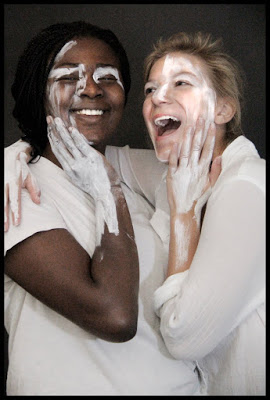
It's no brainer that the media brainwashes our society's beauty standards. It bombards us with notions of what is desirable and who we should be. Photoshopped images of women in magazines imply that girls should be thin and flawless. African Americans are also underrepresented in magazines, and are made to look drastically paler.  Through these set of photos, I'm trying to address this toxic power of the media that is impacting our whole community and convey the beauty of different complexions. In this shoot, I used white paint to address white privilege.

 © Copyright View Kuphirun. All rights reserved.


As the dominant racial group in the United States, whites have distinct advantages. In one frame, Lexi (Right) closes her eyes as a symbol white ignorance at the racial tensions that make being black inherently hard. I kept Ericka's (Left) beautifully dark skin and Lexi's skin untouched as I also want to encourage other girls to embrace their imperfections. Through the juxtaposition and symmetrical form of the models, I hope to communicate a positive message that we can overcome racial inequality and coexist in peace and harmony if we have mutual respect.  In the future, I hope to see more progress and equality in how women are portrayed in the media and beyond.

Why I started Y-roon Thai?

Activism
 

“Do you have makeup on right now?” asked a boy from the audience.
Laughter and whispered speculations were heard before the speaker could wrap her head around the question. Cultural theorist Jean Kilbourne had come to talk to Middlesex School about the toxic and narrow representation of women in media that influences the accepted beauty standards of girls and boys today. I thought Kilbourne was pointing out an obvious flaw of a teen advertising strategy, but comments like mentally unstable and “crazy bitch followed the talk. I was disheartened by the boy’s reaction to such an empowering speech. After all, body image is an emotional and relevant topic for me and my community of teenage girls.
Now that I’m back in Thailand, I see that these issues are neither discussed nor incorporated into our education system. Gender stereotypes are still deeply entrenched in our society. I want to solve this problem by debunking prejudices and encouraging leadership in men to stand up against the inappropriate comments.
Armed with the powerful platform of social media to inspire change and encourage participation, I took action by starting the organization, Y-roon Thai, with my friend. Y stands for “Generation Y” and teenager in Thai is Wai Roon. Using Facebook as my megaphone, I posted videos, photos, and conversations from street interviews with Thai youths.
When the project first started, I was terrified of approaching strangers, and struggled to communicate my ideas and message.
“Ummm…” Voice shaking and standing a little too close: “Does social media increase self consciousness? What roles do men play in setting the standard of beauty for women?”  
“No thanks”
“Sorry, in a rush right now”
“It’s not my thing”
Why wasn’t I getting proper responses? I stopped to reflect, and realized I was asking questions through my owns lens; I prioritized self-reflective answers that may have been as exclusive as the gender stereotypes themselves.

Setting my opinions aside, I tried again:
“Hi.” Big smile, assuring them that I’m not a threat.I know this is random, and you’re in a rush right now, but I’m very interested in hearing from Thai teens. Our voice is very important. Have you ever thought about feminism or discussed it in school?
I began to approach my interviews less deliberately, asking open-ended questions that didn’t set blocks to their thoughts.
Sam, a Thai teen transgender: “I think the biggest issue facing young people today is acceptance from adults. Most adults are still close-minded and not willing to listen to us.”
JayJay, teen singer: “it must be a collective effort rather than just the effort of one person or a social group; gender equality is a men’s issue too.”
After a few successful interviews, it was eye-opening and comforting to know that there are Thai youths who are conscious of these issues, but just aren’t talking about them. My vision for Y-roon Thai started to change as I realized my initial goal to break gender stereotypes had been overly ambitious. Change is hard and Thai’s lack of education, exposure, and “it’s not my business” attitude remain barriers. By continuing existing dialogues and starting new ones, I hope to trigger change on small problems that intertwine into bigger ones; I now see Y-roon Thai more as a platform for discussion.Allowing people to see little pieces of themselves through other people’s story one at a time will hopefully motivate them to introspect and ultimately come to their own realizations. In the end, it's the things I don’t know that push me to pursue my goals and bring me closer to addressing these social issues.

https://www.facebook.com/yroonthai/


All images © View Kuphirun.